Los californios® Home |
Resumé |
Events |
Wares |
Order Form |
Sitemap |
Contact |
Portal
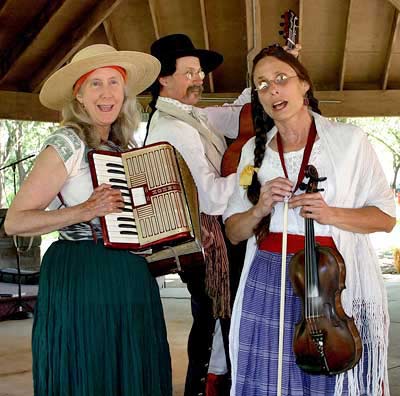
Photo by Jerry Bowen
From left: Janet Martini, David Swarens, Vykki Mende Gray
The Peña Adobe in Vacaville, CA.
|
Los californios®,
based in San Diego, California, play and sing the secular music of
California from the days when our state was part of Spain and then Mexico.
These sweet, melodic pieces include waltzes and polkas used for dancing,
and songs about love and rancho life, often with comic lyrics. Although
the music includes elements of Spanish music, it also includes influences
from European and American folk music — as trading ships often visited the
coast of Alta California, from the indigenous peoples of California, and
from the diverse heritages of the early Mexican settlers.
Los californios® is a
self-supporting project of San Diego Friends of Old-Time Music, a
California non-profit educational corporation. This project works to
expose California audiences to their own historic musical heritage; to
research, document and transcribe social music and dances from eighteenth
and nineteenth century Spanish-speaking Californians; and to teach and
distribute this information to a wide audience of musicians, dancers and
enthusiasts through workshops, performances, articles and papers presented
at educational conferences, and music classes at Sherman Heights Community Center.
For Bookings:
Please Contact David Swarens by Phone: (619)232-4475
Or Send an e-mail to info@loscalifornios.com
Los californios® include:
Los californios® received a People in Preservation Award from
Save Our Heritage Organization for these accomplishments.
Los californios® is a registered
service mark belonging to San Diego Friends of Old-Time Music, Inc.
Preserving Californio Social Music
In the era of Alta (Upper) California, the 5,000 or so
settlers lived far apart, spread between San Diego and Sonoma. So when
friends and relatives gathered at a rancho for a holiday or visit, it was
an occasion for many days of singing, dancing and celebrating.
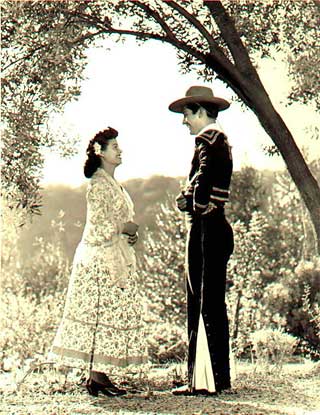
Historical photograph by Irene Welch Garner.
Padua Hills Theatre — The Mexican Players
Conchita Gallardo and Magrucio Jara
Los californios® Collection
|
The californio music all but died out after the
era of the ranchos ended, but songs performed by the last generations of
californios were recorded on wax cylinders by journalist and
folklorist Charles Fletcher Lummis, mostly between 1904 and 1907. Lummis
published a portfolio of 14 pieces from his recordings in 1923. (For more
information about these recordings, see .)
Over time a number of groups continued in efforts to preserve this California heritage:
the Padua Hills Theatre
(The Mexican Players) in Claremont,
the José Arias Troubadours,
Eugene Plummer with his dance group, the folk dance community with dance collectors and teachers like Lucille
Czarnowski and Albert Pill, Gabriel Ruíz and his group of musicians and dancers, the A la California
Club (later calling itself Los Californios),
the Southwest Museum, now part of The Autry
Center, and its adjunct the Casa de Adobe,
Elisabeth Waldo with her creative
compositions based on historic California music,
Elizabeth Erro Hvolboll and Luis Moreno,
Luis Goena and his dancers Los parientes,
Yesteryears Dancers,
Arnold Guerra and his dancers Tatalejos, The Alta California Dance Company,
The Calicanto Associates,
Los Arribeños de San Francisco,
Baile de California
[also on FaceBook at
https://www.facebook.com/ BaileDeCalifornia/],
Los Bailadores of Old Town San Diego,
Los Califas in Petaluma,
El coro hispano de San Francisco,
The Alta California Orchestra
(TACO),
and descendants groups from all over the state.
In the late 1930s
Sidney Robertson Cowell undertook a project to document Northern California Folk Music and included a number
of recordings and photographs of people preserving this tradition of music, including informants like:
Lottie Espinosa, Hilda Duarte Brown and Walter Sebree, and Jessie de Soto performing Spanish-language songs from California;
and
The Boys of St. Joseph’s Seminary, women from the Asistencia at Pala (Pala Indian Reservation), and
the Choristers of St. Anthony’s Seminary performing music from California’s Spanish-era missions.
In the 1950s folk dance academia found itself to be part of the Physical Education curriculum.
Two prominent collectors kept the music and dance alive during this period:
Lucille K. Czarnowski (1897-1985) was on the faculty of the University of California at Berkeley from 1923-1973.
Her
groundbreaking book, Dances of Early California Days, influenced, and continues to influence, generations of dancers.
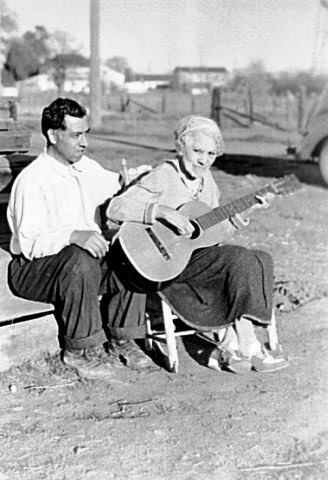
Jessie de Soto (with guitar) and son Tomás in 1939
|
And many people who today know the 19th-century californio dances and dance music can
credit Al Pill (1924-1998), who
dedicated much of his life to keeping californio and Mexican traditional dance
alive. He taught at California State University at Fullerton until 1988. Late in his life, he was acutely aware
of the need to make sure that his dances did not die with him, and reached out to younger persons able to carry
on the traditions.
Another of those links with the past was Luis Goena of Santa Barbara (1928-2014). A student at one time of
Al Pill,
Luis made folk music come alive in Santa Barbara for several generations of dancers, including a suite of californio
dances
with his group Los parientes.
In 1989 a group of San Diego folk musicians, organized by Lee Birch and calling itself
Los californios®, began playing this music and learning these dances. David Swarens knew of
Lummis’ original recordings housed at the Southwest Museum in Los Angeles (a museum that Lummis had helped to
found in 1914) and the group was able to obtain funding through San Diego’s Old Town State Park in order to
obtain tape recordings from those original wax cylinder recordings.
Since those humble beginnings, these San Diego musicians have been privileged to conduct original
research in this field, and to meet and interview a number of the people who have made contributions to
preserving this heritage. The group’s educational mission continues to be extended in many different ways.
Their original transcriptions from the Lummis recordings and other recorded sources are a source of joy for many
a Californian rediscovering Mexican California, their delightful performances at historic sites and museums on both
sides of the border with Mexico enchant people of all ages, their scholarly presentations at universities and for
historic academicians are widely applauded, and their popular recordings,
¡Qué viva la ronda! and
Flowers of Our Lost Romance, are available at a growing number of venues.
For more information about the preservation of Spanish-Language Social Music of the 19th Century
in Southern
California, go to loscalifornios.info.
Recordings
¡Qué viva la ronda!
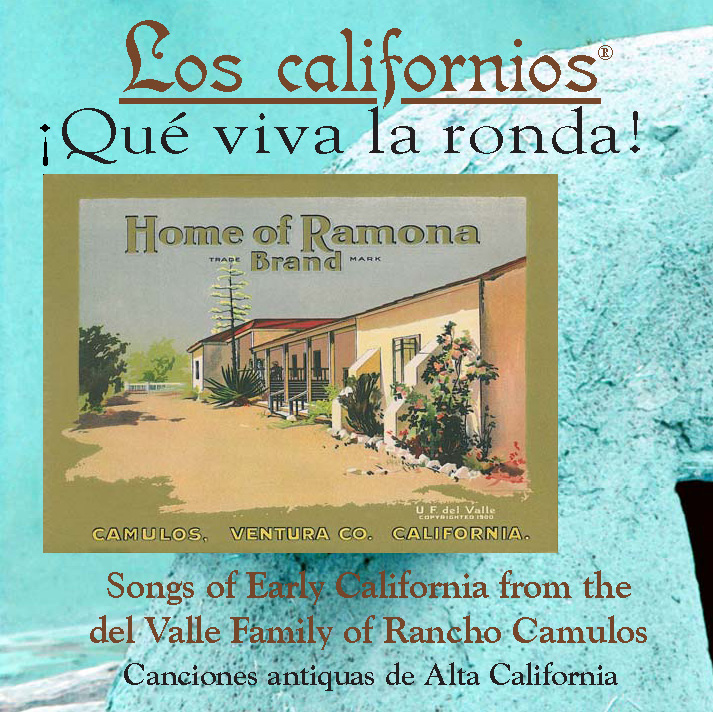
This energetic new CD recording by Los californios® features the songs
collected at Rancho Camulos by Charles Fletcher Lummis from members of the del Valle family household.
Click here
to see the cover, and to read the album notes and words to songs.
Item Number: CD-020 CAM $15.00
Flowers of Our Lost Romance
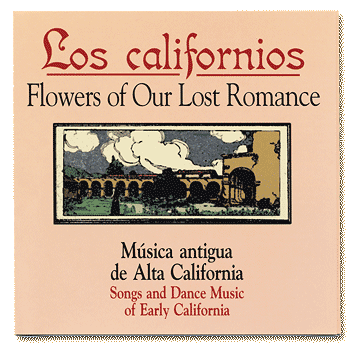 This album fromLos californios® includes 60 minutes of
beautiful early California dances and songs sung in the original archaic Spanish.
Click here
to see the cover, and to read the album notes and words to songs.
This album fromLos californios® includes 60 minutes of
beautiful early California dances and songs sung in the original archaic Spanish.
Click here
to see the cover, and to read the album notes and words to songs.
 Two pieces from this CD are also part of the music used in
The Remuda, a
DVD film by J & S Productions about the evolution of the buckaroo
beginning in California over 200 years ago. Other musicians featured in
this movie include Pedro Marquez, Ian Tyson and Dave Stamey.
Two pieces from this CD are also part of the music used in
The Remuda, a
DVD film by J & S Productions about the evolution of the buckaroo
beginning in California over 200 years ago. Other musicians featured in
this movie include Pedro Marquez, Ian Tyson and Dave Stamey.
Music from this CD was used for a Latino USA program
reporting on the descendants of Spanish and Mexican-era Californians and
their efforts to preserve a genealogical identity.
For a video clip produced by the Lively Arts History
Association using this recording for the audio, click
here.
Click here
for an order form.
CD Item Number: CD-010 FLO $15.00
Cassette Item Number: CAS-010 FLO $10.00
Music Books of Sheet Music Transcriptions
Music of Early California |
El ciego Melquíades Rodríguez
Research by Los californios®
has resulted in a growing number of original transcriptions and
arrangements of songs and dance tunes, many from the Edison wax cylinders
recorded by Charles Fletcher Lummis. This is available as a comb-bound
book containing 402 pages of music transcribed over a period of ten years,
mostly from primary sources, and arranged with chord indications in common
folk music keys. Lead and harmony lines (segunda) are included for most
pieces in the traditional style, and an index to the pieces is included.
Most of these pieces have not been readily available to a general audience
for over a hundred years. These transcriptions finally make this music
once again accessible and available for performers and scholars.Click here for additional
details.
Songs from Rancho Camulos |
Villa Family |
Francisco Amate |
García Family |
Rancho-Era Dances
Joseph María García Manuscript: Volume 1 |
Joseph María García Manuscript: Volume 2 |
Adalaida Kamp
The Big Book:
All the early California material in one giant book
|
Item Number: BK-110 CAL $85.00
|
Volume 1: 1999 Supplement — 38 pages
Volume 2: 2000 Supplement — 32 pages
Volume 3: 2001 Supplement — 40 pages
Volume 4: 2002 Supplement — 44 pages
Volume 5: 2003 Supplement — 44 pages
Volume 6: 2004 Supplement — 44 pages
Volume 7: 2005 Supplement — 44 pages
Volume 8: 2006 Supplement — 56 pages
Volume 9: 2007 Supplement — 60 pages
Volume 10: 2008 Supplement — 62 pages
|
Item Number: BK-001 CAL $10.00
Item Number: BK-002 CAL $10.00
Item Number: BK-003 CAL $10.00
Item Number: BK-004 CAL $10.00
Item Number: BK-005 CAL $10.00
Item Number: BK-006 CAL $10.00
Item Number: BK-007 CAL $10.00
Item Number: BK-008 CAL $15.00
Item Number: BK-009 CAL $15.00
Item Number: BK-010 CAL $15.00
|
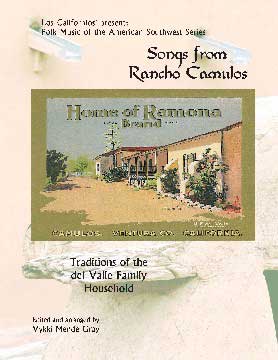
Traditions of the del Valle Family Household
This publication focuses on the repertoire of the del Valle family of Rancho Camulos,
located near Magic Mountain, north of Los Angeles. This is the first segment of the tunes in our larger work to be
broken out by area or informant.
Item Number: BK-201 CAL $10.00
Click on book cover illustration (right) for further description and specific titles.
Recording available separately: see above.
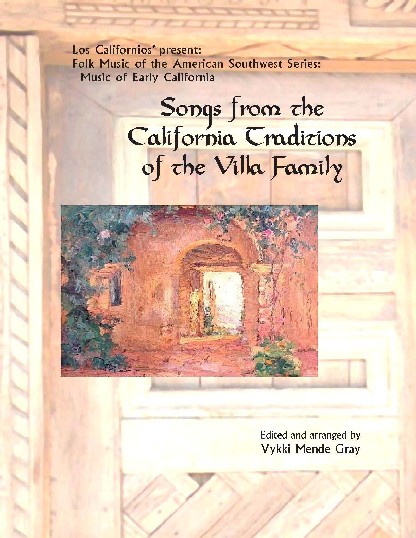
This publication focuses on the repertoire of the Villa family of Los Angeles. This is the second segment
of the tunes in our larger work to be broken out by area or informant.
Item Number: BK-202 CAL $10.00
Click on book cover illustration (left) for further description and specific titles.
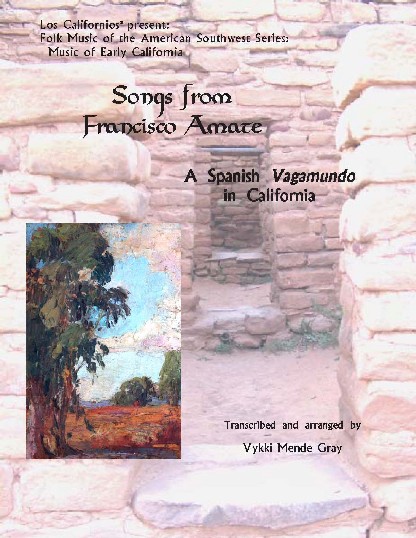
A Spanish vagamundo in California
This publication focuses on the repertoire of Songs from Francisco Amate. This is the third segment of
the tunes in our larger work to be broken out by area or informant.
Item Number: BK-203 CAL $10.00
Click on book cover illustration (right) for further description and specific titles.
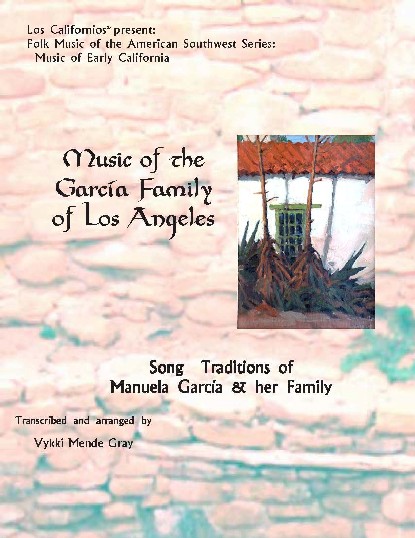
Song Traditions of Manuela García & her Family
This publication focuses on the repertoire of the García family of Los Angeles. This is the fourth
segment
of the tunes in our larger work to be broken out by area or informant.
Item Number: BK-204 CAL $15.00
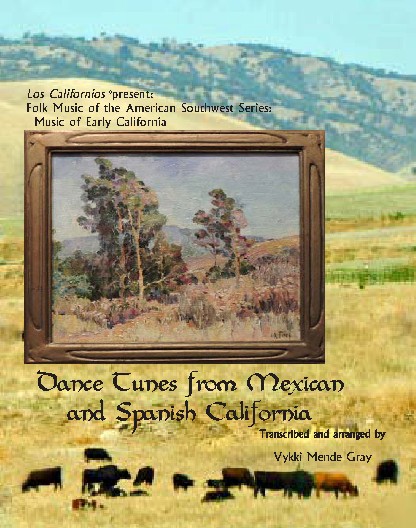
This book of dance tunes is the fifth segment of the tunes in our larger work to be broken out by area
or informant.
Unlike our previous collections, seventeen of the forty-one pieces included in this collection are not included in our
ten-volume Music of Early California collection.
Item Number: BK-205 CAL $10.00
Click on book cover illustration (right) for further description and specific titles.
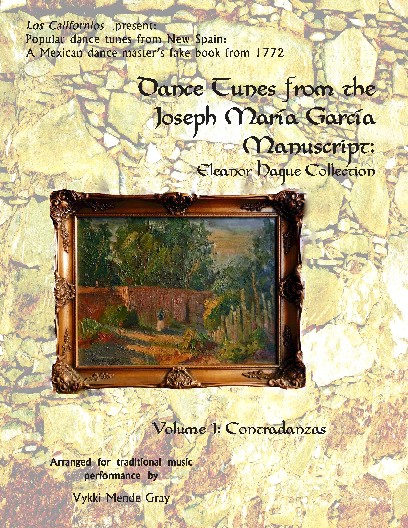
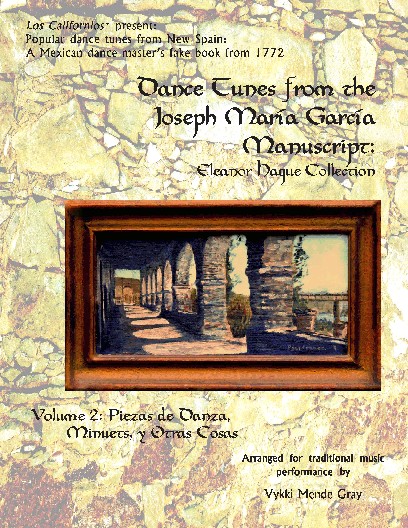
From the Eleanor Hague Collection
at the Braun Research Library, Gene Autry Center
A Mexican dance masters fake book from 1772.
This sixth specialized book of californio music includes 168 seventeenth- and eighteenth-century
contradanza tunes. A few of these tunes are found in our ten-volume Music of Early California collection, but the
vast
majority are new to our collections.
Item Number: BK-206 CAL $15.00
Click on book cover illustration (left) for further description.
From the Eleanor Hague Collection
at the Braun Research Library, Gene Autry Center
A Mexican dance master’s fake book from 1772.
This seventh specialized volume of californio music includes paspies, bureas, rigodones, and
a great
many minuets.
Item Number: BK-207 CAL $15.00
Click on book cover illustration (right) for further description.
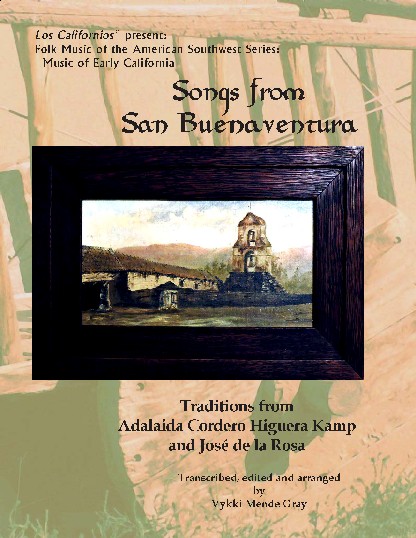
Traditions from Adalaida Cordero Higuera Kamp
and José de la Rosa
This eighth book in the series concentrates on some of the oldest material collected on Lummis’
cylinders.
Adalaida Cordero Higuera Kamp of Ventura recorded not only her own songs, but also recorded a great many
pieces that she
learned from José de la Rosa. This 94-page book contains 75 pages of music, an introduction, and extensive indices making
it easier to located
particular songs. And there are a great many pieces that have not been previously available. It has taken 20 years to finally
figure some of them
out, and that only happened with lots of help. The results are worth it! These archaic songs help to open a new window on
the
californio society of that time.
Item Number: BK-208 CAL $15.00
Click on book cover illustration (left) for further description.
El ciego Melquíades
The Fiddle Tunes of Melquíades Rodríguez,
a tejano fiddler of yesterday
This Texas-Mexican fiddler recorded in San Antonio, Texas from 1935 until about 1950. His popular
and lively style of fiddle-based dance music was about to succumb to the post World War II trend for louder and flashier
sounds. As the fiddle was replaced by the accordion in Tex-Mex music, these fiddle tunes faded from the popular
scene.
Discover for yourself the delights of playing the repertoire of this Mexican and tejano
heritage. Click on book cover illustration (right) for further description and specific titles.
Item Number: BK-301 TEJ $15.00
Charles Fletcher Lummis
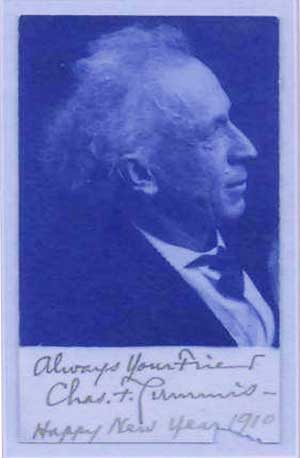
Original autographed photo by Charles Fletcher Lummis,
of Charles Fletcher Lummis
“Always your friend
Chas. F. Lummis — Happy New Year 1910”
Los californios® Collection
|
Charles Fletcher Lummis (1859-1928) was born in
Massachusetts, but came to be an avid promoter of the American Southwest.
He walked from Ohio to Los Angeles in 143 days, and published a journal of
his trip, A Tramp Across the Continent, in 1892. In addition to the
celebrated Edison wax cylinder recordings that he made to preserve
historic Spanish-language secular songs of California and Native American
music of the Southwest, Lummis helped found the Landmarks Club in 1897 to
restore the California missions, founded the Sequoia League in 1901 to
protect America’s native people, and helped create the Southwest Museum in
1914. Lummis was an editor for the Los Angeles Times and wrote many other
books including The Land of Poco Tiempo (1893). El Alisal, Lummis’ Los
Angeles home and gardens, is now the headquarters of the Historical
Society of Southern California and is open to the public.
For more information about Lummis and his Edison wax
cylinder recordings, go to http://loscalifornios.info
Mariachi Sherman
Mariachi
Sherman, out of Sherman Heights Community Center in San Diego, was a
special project of Los californios®. These
enthusiastic young musicians learned music and performing skills, and
in turn providing community service through their enchanting
performances both in Sherman Heights and in the larger San Diego
community. The program is currently suspended due Vykki’s health proplems.
Los californios® is a registered
service mark belonging to San Diego Friends of Old-Time Music, Inc.,
a California non-profit corporation.
Contact Los californios® at
info@loscalifornios.com
Find Los californios® on Facebook.
© Vykki Mende Gray, 2020
All rights reserved.
Web design: Ellen Wallace and Vykki Mende Gray
All rights reserved.
Portal
| Los californios®
| History of This Music
| Padua Hills Theatre
| San Diego Friends of Old-Time Music
| Sitemap
|